


1. The Thin Line Between Safety and Waste
Disposable nitrile gloves feel deceptively simple—just pop them on and get to work. Yet beneath that smooth surface, every glove balances three forces: protection, dexterity, and cost. Thickness—measured in “mils,” or thousandths of an inch—is the dial that controls all three. Dial it too low, and you invite rips, chemical seep-through, and bruised knuckles. Dial it too high, and you overspend, over-perspire, and fumble small parts.
That balancing act explains why a paint sprayer might swear by 8 mil nitrile gloves while a tattoo artist stays loyal to 6 mil nitrile gloves in sleek black nitrile gloves all day long. This article breaks down the science, regulations, and user experience behind thickness so you can dial in the perfect glove for your crew, your budget, and your compliance demands.
2. Anatomy of a Mil: What a Thousandth of an Inch Really Means
A single mil (0.001 inch or 0.0254 mm) seems trivial—until you multiply it across an entire glove. Jumping from 3 mil to 8 mil more than doubles the material at every stress point: fingertips that peel stickers, palms that wrestle torque wrenches, cuffs that snap on and off a hundred times a day.
Thicker nitrile sheets resist pinhole formation, slow down chemical permeation, and absorb minor punctures before they propagate into tears. But they also stiffen the glove film, which can reduce tactile sensitivity by up to 30 % in lab tests. The sweet spot differs for each task, but understanding how those microscopic layers perform lets you buy with confidence instead of guesswork.
3. How Manufacturing Controls Thickness (and Why It Can Vary)
Modern dipped-film lines meter thickness through:
- Ceramic formers shaped like hands that travel through nitrile tanks.
- Dwell time in the liquid compound—longer dips build thicker walls.
- Speed of withdrawal—slower withdrawal leaves more compound clinging.
- Drying ovens that evaporate moisture and lock in final gauge.
Because climate, compound viscosity, and even apron drag affect film build-up, reputable brands drill down on statistical process control to keep variation within ±0.3 mil. That matters: a case labeled “6 mil” that occasionally spits out 4.6 mil fingers undermines safety just as surely as a cracked helmet. Always request recent thickness data, not just marketing copy, when you’re evaluating suppliers—especially overseas sources.
4. Standards and Testing: Who Says “Thick Enough”?
Two benchmark tests dominate North American glove compliance:
- ASTM D5151 – water-leak test for pinholes (medical and food service).
- EN 374 / ASTM D6978 – chemical permeation and degradation (industrial and chemo-rated).
Neither test specifies an exact mil range; instead, they set performance floors (e.g., no leaks at 1 L water pressure for 2 minutes, or <0.01 µg/cm²/min permeation for six specified chemicals). Manufacturers hit those marks with different design knobs, but thickness is the simplest lever. That’s why exam-grade gloves cluster from 3 mil to 6 mil, while fentanyl-resistant or solvent-handling gloves trend toward 7 mil and above.
Takeaway: Certification is function-based, not mil-based, yet thicker gloves usually pass tougher functions with wider safety margins.
5. The Myth of “One-Size-Fits-All” Mil Ratings5.1 Food Service vs. Automotive
A line cook reaching into hot fryer baskets often needs just 4 mil of grease protection—more heat than puncture risk. A mechanic prying off an oil filter faces lugs, burrs, and solvents that chew through thin film in minutes. Upgrading that mechanic to 8 mil nitrile gloves can cut downtime by half a dozen changes per shift—saving labor, landfill volume, and surprise skin contact with ATF.
5.2 Medical Exam vs. Chemo Compounding
Nurses fitting catheters prioritize sensitivity; 5 mil is plenty. Pharmacy techs compounding cisplatin must instead meet USP <800>—a standard that often requires double-gloving or a single 7-mil chemo-rated glove. The cost delta is justified by toxicity stakes.
6. Cost Math: When Paying for Thickness Saves Money
Thicker gloves cost more per unit—no secret there. But consider the equation:
If a 4 mil glove tears four times as often as a 6 mil glove and your techs burn three minutes washing and regloving each time, the soft costs dwarf the pennies you saved on purchase price. Field studies at plating shops show that switching from 5 mil to 8 mil cut average glove changes from 14 to 5 per 10-hour shift—recouping the higher unit price in under two days.
7. 6 Mil Nitrile Gloves: The All-Around Workhorse
Why do so many pros land on 6 mil nitrile gloves? Because they straddle the line between sensitivity and ruggedness. At 0.152 mm, they:
- Withstand most degreasers and mild acids for >30 minutes.
- Resist tears from box-cutters better than 4–5 mil.
- Still allow touch-screen use and suture tying.
They’re the “F-150 of disposables”—versatile enough for dental suction one hour, loading docks the next. If you buy one thickness for a mixed-duty facility, 6 mil typically offers the lowest total cost of ownership.
8. 8 Mil Nitrile Gloves: Built for Brutal Jobs
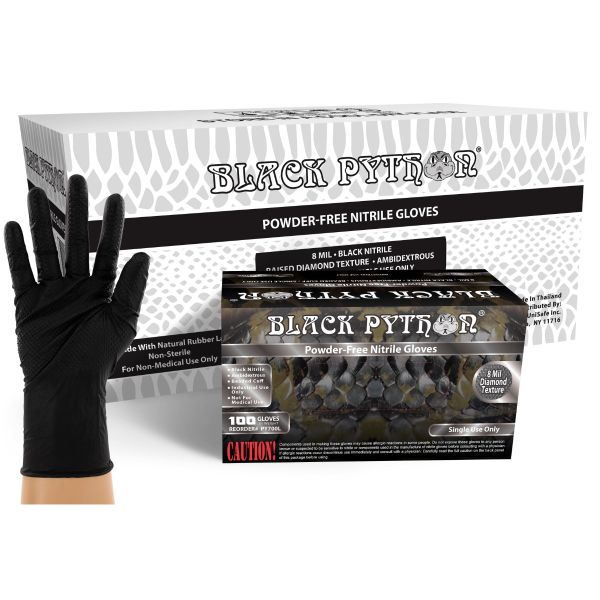
When tasks shred lesser gloves—think salvage yards, HVAC ductwork, or epoxy flooring—8 mil nitrile gloves shine. Their advantages include:
- Up to 3× puncture resistance over 4 mil.
- Extended chemical breakthrough time (trichloroethylene, MEK, acetone).
- Reduced hand fatigue from fewer changes (yes, thicker can be less tiring).
Downsides? Slightly reduced fingertip feel and a 10-20 % price premium. Yet crews often offset that cost by using half as many gloves per week.
9. Color and Thickness: Why Black Nitrile Gloves Are Often Thicker
Colorants do more than style. Carbon-black pigment makes black nitrile gloves naturally more opaque and UV-resistant—qualities prized by tattoo artists, law enforcement, and detailers who hate seeing ink stains or brake dust on their hands. Many black gloves are factory-made at 6–8 mil to match those rougher conditions.
So if you see “black” and “4 mil” on the same spec sheet, raise an eyebrow: the combination isn’t impossible, but you’ll want to confirm the glove isn’t just dyed thin film masquerading as pro-grade gear.
10. Breathability, Sweat, and the “Hand Sauna” Effect
Thicker nitrile restricts moisture vapor transmission. Workers in hot bays sometimes ditch 8 mil gloves simply because their palms turn into slip-n-slide zones. Solutions:
- Rotational wearing—alternate thin for light tasks, thick for heavy pulls.
- Powder-free chlorination—glove interiors treated to reduce tackiness.
- Wicking liners—thin cotton under-gloves that soak sweat yet maintain chemical barrier.
Choose thickness in tandem with climate control; a perfectly safe glove left on the bench helps nobody.
11. Environmental Impact: More Material, But Fewer Gloves
Eco-math can surprise skeptics. Yes, thicker gloves use more nitrile per piece, yet studies comparing landfill tonnage find parity or even less waste at higher mils because users discard far fewer gloves overall. A warehouse that slashed glove changes by 70 % after a switch to 8 mil actually reduced total polymer waste by 18 %.
Corporate sustainability reports increasingly include “glove turn-over rate” as a KPI. If your ESG audits overlook disposables, thickness optimization offers a quick win.
12. Tips for Selecting the Ideal Thickness
- Audit Tasks, Not Job Titles – A janitor who only wipes counters may tolerate 4 mil, but one who strips floors needs 6 mil for stripper chemicals.
- Map Chemical Contact Time – If solvents sit on the glove longer than 10 minutes, jump a mil tier or choose specialty coatings.
- Test, Don’t Assume – Order sample boxes in both 6 mil and 8 mil. Have staff record changes, tears, and feel over three shifts. Data beats opinions.
- Mind the Size Curve – Thick gloves cling tighter; some users size up for comfort. Factor that into inventory levels.
- Watch Heat – Fry lines and foundries should combine higher mils with heat-rated over-gloves to avoid thermal burns.
13. Common Myths—Busted
Myth 1: Thicker Gloves Always Last Longer
Not if compound quality is poor. A cheap 8 mil glove with weak cross-linking can split sooner than a premium 6 mil.
Myth 2: Thin Gloves Are More Tactile for Everyone
Surgeons train for micrometer movements; an auto painter might find 6 mil steadier because fewer micro-tears mean less anxiety mid-spray.
Myth 3: Black Nitrile Gloves Hide Contamination
They hide stains, yes, but fluorescing inspection lights still reveal micro-leaks. Don’t skip visual checks just because the glove is dark.
14. Regulatory Drift: How Tariffs and Imports Affect Thickness Choices
Tariffs on Asian nitrile imports have nudged some buyers to “skinny down” gloves to stay within budget. That short-term fix spikes failure rates and worker injuries—costs regulators increasingly track. In 2025, OSHA citations for inadequate hand protection surged 17 % after several companies substituted 4 mil for 6 mil without hazard reassessment.
Lesson: Let the task dictate the mil, not the tariff sheet. If budgets bleed, renegotiate vendor terms or streamline SKUs—don’t compromise thickness below risk tolerance.
15. Field Case Studies15.1 Collision-Repair Shop
Problem: Techs averaged 22 glove changes/day with 5 mil blues.
Solution: Switched to black nitrile gloves at 8 mil.
Result: Changes fell to 8/day, acetone dermatitis dropped to zero, and glove spend decreased 12 % because usage plummeted.
15.2 Veterinary Clinic
Problem: Mixed 4 mil exam gloves for routine shots and orthopedic surgery. Tears common during bone pinning.
Solution: Standardized to 6 mil nitrile gloves across the board.
Result: Uniform SKU simplified storage, and surgical tear rate declined 60 % without sacrificing palpation feel.
16. Future Innovations: Thickness Meets Tech
- Variable-Gauge Gloves – Engineers are prototyping gloves with 8 mil fingers and 5 mil palms—thick where punctures strike, thin where feel matters.
- Micro-textured 6 mil – New molds add nano-scale grip without extra bulk, letting 6 mil replace 7 mil in oily tasks.
- Reclaimed Nitrile Blends – Recycling adds fillers that stiffen film; manufacturers offset by reducing thickness 0.5 mil while maintaining strength. Expect eco-friendly 5.5 mil options soon.
17. Buying Checklist
- Verify Labeled Thickness at Fingertips
- Ask for Permeation Charts for chemicals used >5 minutes.
- Demand Lot-Specific QC Data—aim for Cpk ≥1.33 on mil gauge.
- Order Samples in Both 6 mil and 8 mil; run side-by-side for one week.
- Inspect Edge and Seam Consistency—ragged cuffs indicate uneven dips.
- Document Worker Feedback—comfort complaints often predict non-compliance.
18. Conclusion: Turn Thickness into a Competitive Edge
Choosing glove thickness wisely isn’t just a safety box to tick—it’s a productivity lever and a profit safeguard. Move too thin and you’ll bleed money in changeovers, accidents, and morale. Go too thick and you waste cash upfront and dexterity downstream.
By understanding where 6 mil nitrile gloves excel, when 8 mil nitrile gloves become essential, and how black nitrile gloves fit specialized demands, you’ll equip your team with a glove they barely think about—because it simply works.
Take the time to measure tasks, test options, and lock in the mil that matches your real-world risks. Your hands—and your bottom line—will thank you.